
What I Can Do For You
Every project that comes through my door gets my full attention and a straightforward answer. If trees are part of your work, your property, or your problem, I can help.

Most people don't need a lecture on arboriculture. They need to know whether a tree is safe, whether their project can move forward, and what it's going to take to get there.
That's what I focus on.
I've spent nearly a decade working trees from the ground up: as a climber, a crew lead, a trainer, a utility specialist, and a consulting arborist. I brought all of it into this practice. You get someone who's actually been in the trees, not just studied them.
ARBORIST REPORTS & TREE PROTECTION PLANS
For developers, homeowners, design professionals, and municipalities
If your project requires a permit, an application, or municipal approval, there's a good chance you need an arborist report. Getting that report done right the first time matters.
Revisions cost time, and time costs money.
I write reports that municipalities accept. I've been through the process enough times to know what reviewers are looking for, how to structure arborist reports to minimize back-and-forth, and how to design tree protection plans that work. I've designed the solutions. I've executed them in the field. That's the difference.
What this includes:
Arborist Reports for Development & Permit Applications: Tree inventory, condition assessments, impact analysis of proposed work, and recommendations for retention or removal, formatted to meet municipal requirements for site plan approvals, building permits, minor variances, and development applications.
Tree Protection Plans: Detailed plans specifying which trees are to be retained, where protection fencing goes, what activities are restricted within root zones, and what monitoring is required during construction. Not a boilerplate document. Specific to your site, your trees, and your municipality's standards.
Tree Inventory & Assessment: Systematic inventory of trees on a property or location, with condition ratings, observations, and management recommendations. Useful for developers assessing a site pre-purchase, municipalities managing street tree assets, and property managers planning long-term maintenance.
TREE RISK ASSESSMENT (TRAQ)
For property owners, municipalities, facilities managers, and insurance purposes
Before I ever wrote a tree risk assessment for a client, I was assessing trees for a different reason: I was about to climb them. For years, reading a tree's structure wasn't a professional exercise. It was how I decided whether it was safe to trust my life to it. That background is the foundation of every assessment I do now.
A tree doesn't have to look unhealthy to be a risk. Structural defects, decay, root problems, and past damage can all compromise stability in ways that aren't obvious without a trained eye. I'm TRAQ-qualified (Tree Risk Assessment Qualification), which means I also apply a standardized, internationally recognized methodology on top of that field experience, not instead of it.
If you have a tree you're unsure about, a complaint from a neighbour, a storm event you need assessed, or a portfolio of trees that need to be prioritized for care, this is where I start.
What this includes:
Level 1: Limited Visual Assessment: A walk-through assessment to identify trees that require a more detailed evaluation. Appropriate for large properties, campuses, or municipal portfolios where a systematic scan is needed.
Level 2: Basic Risk Assessment: The standard TRAQ assessment: a ground-level visual inspection of the whole tree, considering failure potential, likelihood of impact, and consequences of failure. Includes a written report with risk ratings and recommended actions.
Level 3: Advanced Risk Assessment: When a Level 2 assessment identifies concerns that require closer investigation: climbing inspection, probing, or other diagnostic tools. I go further when the situation calls for it.
For property owners, design professionals, contractors, and anyone who needs a straight answer
CONSULTATION & ADVISORY
Sometimes you don't need a full report. You need a BCMA-level opinion on a specific question, a second read on an existing assessment, or someone to walk a site with you and tell you plainly what you're dealing with.
That's what this is. A focused, professional consultation with someone who has the credentials and field experience to give you an answer you can actually rely on. Whether you're a homeowner trying to understand a tree before you act on it, a contractor who hit a complication on site, or a design professional who wants an arboricultural read before you finalize a layout, I can help.
I also work with other arborists who want a BCMA-level review of their assessments, or who need a second opinion for a complex or high-stakes situation.
What this includes:
Site consultations for property owners with specific tree concerns
Pre-design advisory for architects and landscape architects before drawings are locked
Review of existing arborist reports or municipal conditions
Contractor consultations when site conditions raise tree-related questions mid-project
Professional peer review for arborists seeking BCMA-level input
Phone or virtual consultations when a site visit isn't required
BUTTERNUT HEALTH ASSESSMENT
For landowners, developers, and municipalities working in Southern Ontario
The Butternut (Juglans cinerea) is a Species at Risk in Ontario. Under O. Reg. 830/21, landowners and developers may be required to have Butternuts assessed by a qualified Butternut Health Expert before any work that might affect them. I’ve undergone this training.
If you have Butternuts on your property or within your project area, I can conduct the required health assessment, classify each tree according to the provincial criteria, and provide the documentation you need to comply with Ontario's Species at Risk requirements. This isn't a service you want to skip. Getting it wrong carries real regulatory consequences.
These are hands-on services I provide directly on-site, typically as part of a larger consulting engagement. No crew. No subcontractor. No extra coordination.
FIELD SERVICES
When field work is required, I do it.
Tree Protection Fence Installation: Physical installation of tree protection fencing to municipal or project specifications, prior to construction commencing. Properly installed and documented protection is the first line of defence for retained trees on any build site.
Air Spade Root Investigation: Subsurface root mapping, root collar excavation, and soil decompaction using an Air Spade 2000, which I own and operate. Fast mobilization, accurate documentation, and no guesswork about what's happening underground. For full details, see the dedicated Air Spade page.
Pre-Construction Clearance Pruning: Structural pruning and clearance work carried out before construction begins, to prepare retained trees for the stress of the build and ensure site access without damaging root zones or canopy structure.
Advanced Climbing Inspections & Upper Canopy Work: Some defects can't be identified from the ground. Where a full canopy inspection is warranted, I conduct it myself using professional climbing techniques and equipment. This is the same skill set I built over years as a climbing arborist, applied now to diagnostic and consulting work. If the information is in the upper canopy, I'll go get it.
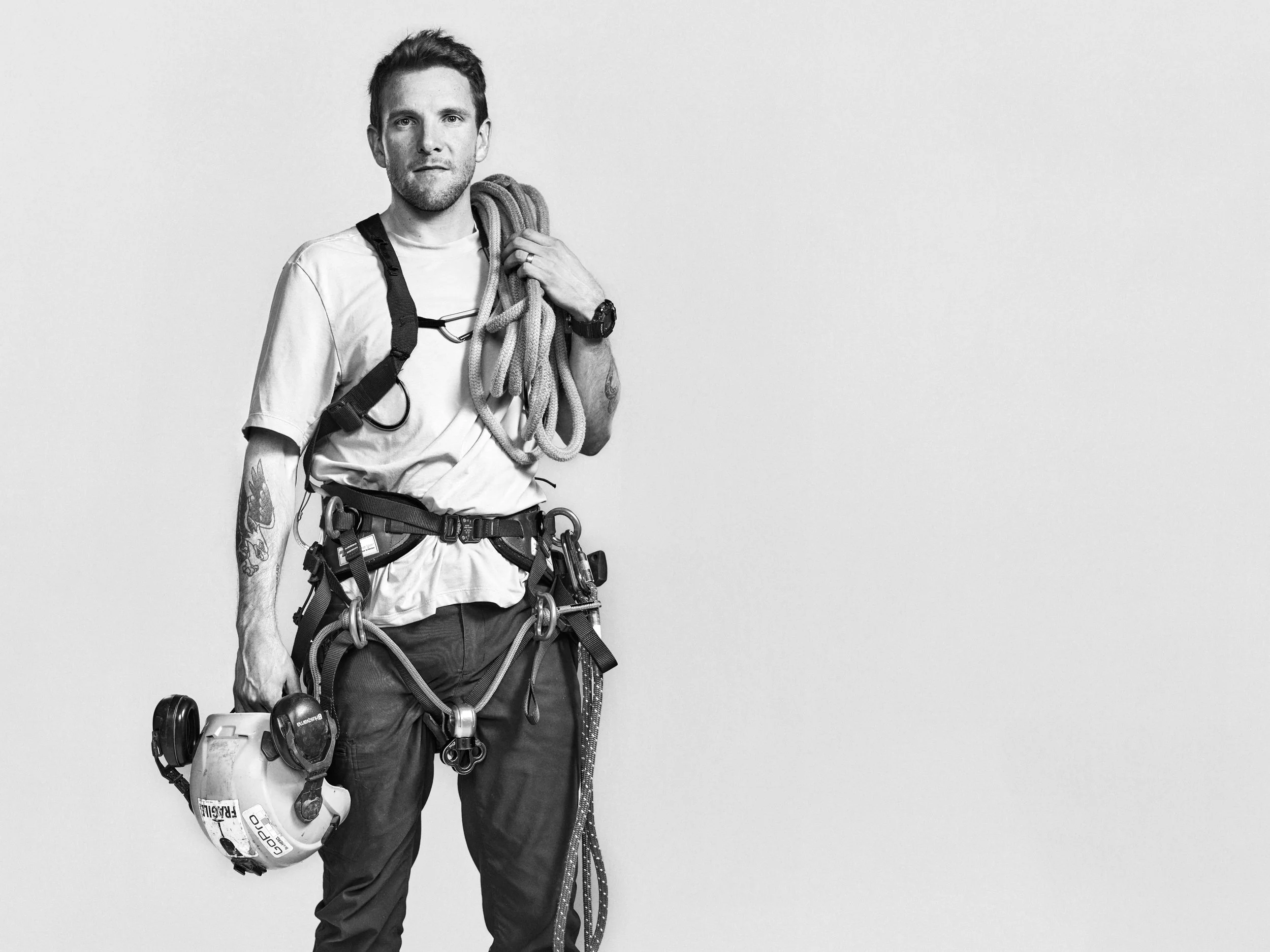
I'm one of fewer than 40 Board Certified Master Arborists in Ontario. The BCMA is the highest credential in arboriculture. I also hold the ISA TRAQ qualification, the 444B Journeyman Utility Arborist certification, and designation as a Butternut Health Expert under Ontario's Species at Risk legislation.
Almost a decade ago I started as a groundsperson with no background in the industry. I worked up through climbing, utility pruning, crew leading, training, and consulting. I've been on hundreds of job sites across Southern Ontario. That experience doesn't stay at the door when I write a report or design a protection plan. It's in every observation and recommendation I make.
I work independently, which means when you hire me, you're working with me. Not a junior consultant. Not a rotating cast of staff. You get a direct line, a fast turnaround, and someone who treats your trees like they're in my own backyard.
I take pride in every square foot of urban forest entrusted to my care. This work is my best chance to make a real impact on the world around me. I don't take that lightly.
A few things worth knowing:

Not Sure Where To Start?
That's normal. Bring me your situation and I'll tell you exactly what you need, and what you don't. No obligation, no upsell.